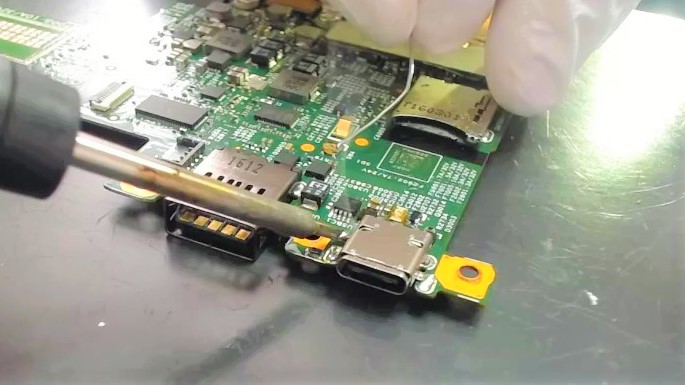
ATTENTION! PLANNING TO GO ON VACATION OCT 31ST 2026, so if you reading this message DO NOT SEND ANYTHING IN If your laptop only charges when you wiggle the USB-C power cable, or if it has stopped charging entirely because the connection was wiggled and jiggled too much or damaged from a drop, the internal USB Type-C port needs to be replaced.
We specialize in advanced micro-soldering, desoldering broken USB-C jacks from laptop motherboards and soldering brand-new, original manufacturer ports in their place. This service applies to all major laptop makes, models, and gaming systems.
Flat-Rate Pricing (Inflation Adjusted for 2026)
- $150 Flat Rate: Covers parts and labor if you ship the entire laptop.
- $100 Flat Rate: Covers parts and labor if you send only the motherboard.
- No Fix, No Charge: If the board is unfixable, your uncashed payment is returned in full.
- 30-Day Guarantee: A 30-day money-back guarantee is provided on all soldering work.
The Reality of USB-C Port Repairs
Unlike standard power jacks which have a 99% success rate, even if we replace the USB Type-C connector, it is not guaranteed that the laptop will work fine due to the complexity of the motherboard circuitry.
- High Success Rate: If you can still wiggle the connector to the point where the laptop powers up, then we will replace the jack and everything will work fine. Send it over, we will take care of it.
- 50/50 Chance on Dead Units: If you wiggled the connector until the laptop completely died and no longer responds, there is a 50% chance the internal power traces or chips are shorted out. In many cases, we can run jumper wires under the microscope to restore power, but the laptop will work exactly 50% of the time based on charger orientation. Your DC plug has a top side and a bottom side; if you plug it in facing upside up, the laptop will work, but the other way around it won’t. We will mark which way is up for your convenience.
- Faulty Charging Cables: Many USB Type-C jacks fail due to a faulty or crooked tip on your original power supply cord. To prevent your new jack from breaking again within a few months, we strongly recommend trying another power supply or purchasing a new adapter after the repair.
- No Prior Repair Attempts: We do not accept boards that have been previously worked on by other repair shops or individuals attempting to remove the broken connector with hot air or soldering irons.
Supported Laptop Models & Success Expectations
Lenovo ThinkPad X1 Carbon (Gen 10 & 11): Both ports are usually fixable. These are highly common at our lab.
Lenovo ThinkPad X1 Carbon (Gen 9): Usually both ports are fixable. If wiggled too much, components behind the jack can get damaged, but most Gen 9 units repair successfully.
Lenovo ThinkPad X1 Carbon (Gen 7 & 8): High success rate if the laptop still shows signs of life when wiggled just right. Gen 8 features an inner trace design; if you smell burning from inside the board, it is an unrepairable trace fault. Physically dropped units repair beautifully.
Lenovo ThinkPad X1 Carbon (Gen 6): Exceptional success rate if the board layout has no prior repair attempts. We can solder every rear pin cleanly back to the motherboard pads.
Lenovo ThinkPad E14 & E15 (Gen 1, 2, 3, 4 / Motherboard NM-C421): Very common and straightforward repairs. Usually, these jacks just get crooked upward. Gen 1 models occasionally have a chip failure if stuck at 5V instead of boosting to 20V, which we can replace. Gen 2 models have a 50/50 success rate if the inner pin row is physically severed.
Lenovo ThinkPad T480, T480s, T580, T495s, L14, L15, P52s: Standard replacements. If completely dead, the rear row of pins often breaks off the traces, resulting in single-sided (50% orientation) charging functionality after a successful port installation.
Lenovo Flex 7 14IRU8 Usually works fine after the usb c replacement
Lenovo ThinkPad T16 Gen 3: Both charging jacks are fully replaceable and respond excellent to service.
Lenovo ThinkPad E590, E490, E495, E480, E585, E485: Fixable as long as you can still power it up intermittently. If the jack is physically broken from a drop, success is high. If it stopped working all of a sudden with no physical force, the power controller chip is likely dead.
Lenovo Yoga 920-13IKB & Yoga X1 (Gen 2 & 6): Gen 2 features a 90% success rate. Gen 6 can suffer from firmware handshake faults if completely dead, but wiggling units resolve perfectly.
Lenovo Thinkpad P14S Gen 4 Please only send these in if you had to wiggle the connectors to make the system work, do not send this laptop in if it died for no reason all of the sudden
Dell Chromebook 3110 Please only send these in if you had to wiggle the connectors to make the system work, do not send this laptop in if it died for no reason all of the sudden. Success rate is good assuming you wiggled the connector.
HP Spectre x360 (13″ & 15″ Series): Both ports must be physically broken (e.g., dropped on the cord). If it suddenly stopped working for no reason with no physical damage, do not send it in. Requires a genuine high-wattage genuine HP Type-C adapter.
ASUS ZenBook (13/14, UX482, UX392 Duo Series): Requires extensive aftermarket jack modifications to sit flush with the casing, but the boards handle the desoldering process exceptionally well.
Dell Inspiron & XPS Series (13 9300, 7306 2-in-1): The left side port is fixable via jump wires if pads are torn. Right side ports frequently suffer structural trace loss that limits repair. Works well if internal copper remains clean.
Acer Chromebooks & Swift Series (CP311, SF713-51): Swift 7 repairs are very straightforward and work perfectly. CP5-471 models are completely unfixable if dead and should not be sent in.
Mailing Instructions
Follow these direct steps to send your device or standalone motherboard to our lab. (You may keep your hard drive at home; passwords are not required).
1. Include Payment in the Box
- Include $150 for a complete laptop or $100 for just the motherboard.
- We accept cash or checks made payable to: CONNECTOR REPLACEMENT LLC
- Place the payment in an envelope between the screen and the keyboard.
2. Provide a Prepaid Return Shipping Label
- Purchase a prepaid return shipping label from UPS Ground or FedEx Ground and place it inside your box.
- Take a photo of the label for your records to track it on the way back.
- Worst-Case Scenario: If your shipping center cannot print a return label, include cash or a check for return shipping: $15 for a full laptop or $10 for a motherboard. (No postage stamps).
3. Pack and Ship Your Device
Before sealing the box, double-check that our shipping address and your return address match exactly on your paperwork. Wrap everything securely in bubble wrap using your own box to avoid retail packaging surcharges. Send to:
527 DEER RUN
FOX LAKE, IL 60020
Phone: (847) 529-9441
Turnaround & Local Walk-Ins
USB-C motherboard repairs require precise microscopic work. Bench turnaround time is 2–3 business days from the day we receive your box.
Local Chicagoland Clients: Walk-in services are welcome at our Fox Lake facility, but please note that same-day or 2-hour service is not available for Type-C ports due to the complexity of the microscopic soldering process.
Service Workflow
We receive your package, carefully disassemble the casing, desolder the faulty jack directly from the laptop motherboard under a microscope, solder a brand-new replacement charging connector, and test the connection.
If the repair is successful, we keep your payment and the laptop is returned using your label. If the board is unfixable, your uncashed payment is placed back in the box and the device is returned. We have operated this way for over 25 years, resulting in hundreds of 5-star reviews across Facebook, Yelp, the Better Business Bureau (BBB), and Google.
Contact Information
Please include the exact make and model of your laptop in all communications.
- Text Only: (847) 529-9441
- Email: portrepair@gmail.com
Microscopic Bench Diagnostics: Case Examples
What are the cases of USB type C failures you can’t fix? When a charging jack is wiggled heavily up and down, it risks ripping the microscopic structural solder pads clean off the motherboard circuit layer. Below are real diagnostic macro examples from our repair bench detailing circuit trace integrity requirements:
Case 1: Severely Torn Motherboard Traces (50/50 Survival Chance)
If you had to wiggle the plug (tip of the cord) in an UP/DOWN motion before it stopped working, then in these cases the rear pins on the USB Type C usually take out the pads on the motherboard. These types of repairs are ridiculously complicated but we can usually make it work so that your laptop will work exactly 50% of the time. You probably don’t know it but your DC plug that you put into the charge port has a top side and a bottom side. If you put the DC plug into the laptop facing up side up, the laptop will work, the other way around it won’t work. Here is why: every USB Type C charge port has 12 pins on the top and 12 pins on the bottom. When you start wiggling the DC plug up and down, the top 12 pins in the back come off the board taking out the soldering pads from the motherboard.
If the jack takes out traces as in the picture below, it is an extremely complicated micro-soldering job:

You see the brown color legs in the picture above? That is in fact parts of the motherboard layer. These are the solder pads to which the silver pins should be attached. This is the standard case of a jack that was wiggled up and down causing the pads to pull completely off the motherboard in the back of the jack. The problem here is that the new jack has nothing left to be soldered to.
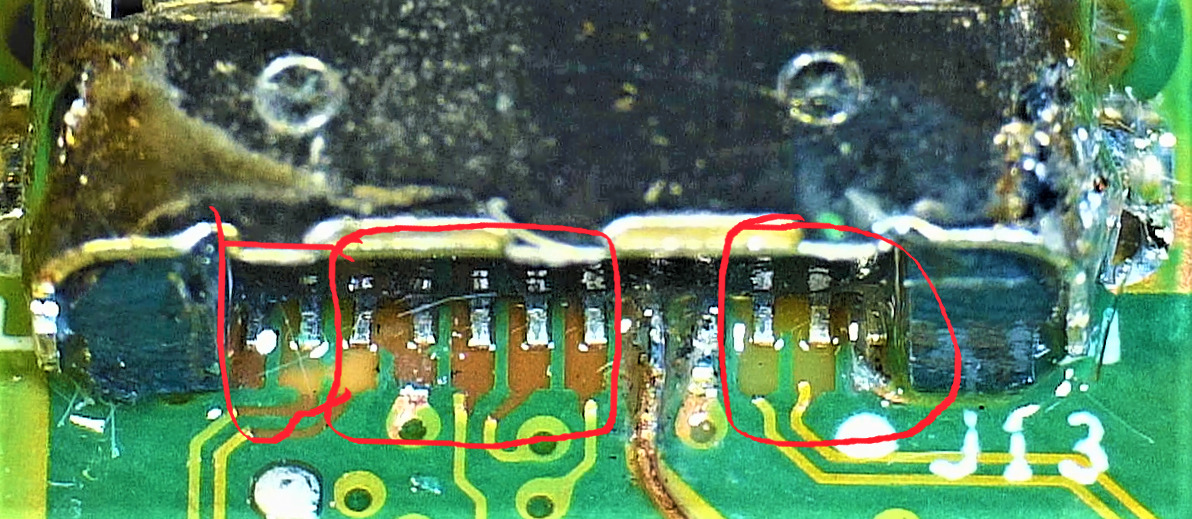
From the picture above, you can see that 9 pins have no pads left to be soldered to. 2 pins have a wire connected to a nearby component, and 1 pin has a micro-soldering bridge done to the nearby trace. It takes hours of precision work under the microscope to run individual microscopic jumper wires without shorting anything out. If your board layout looks like this, it will charge perfectly as long as you use the plug facing the designated marked side up.
Case 2: Ideal Board Condition – No Broken Traces (99% Success Guaranteed)
Here is a good example of a USB Type-C jack that was broken simply because the inner plastic piece of the jack got damaged due to the faulty plug. As you can see, all traces are intact (inner and outer) and we were able to make it work 100%.
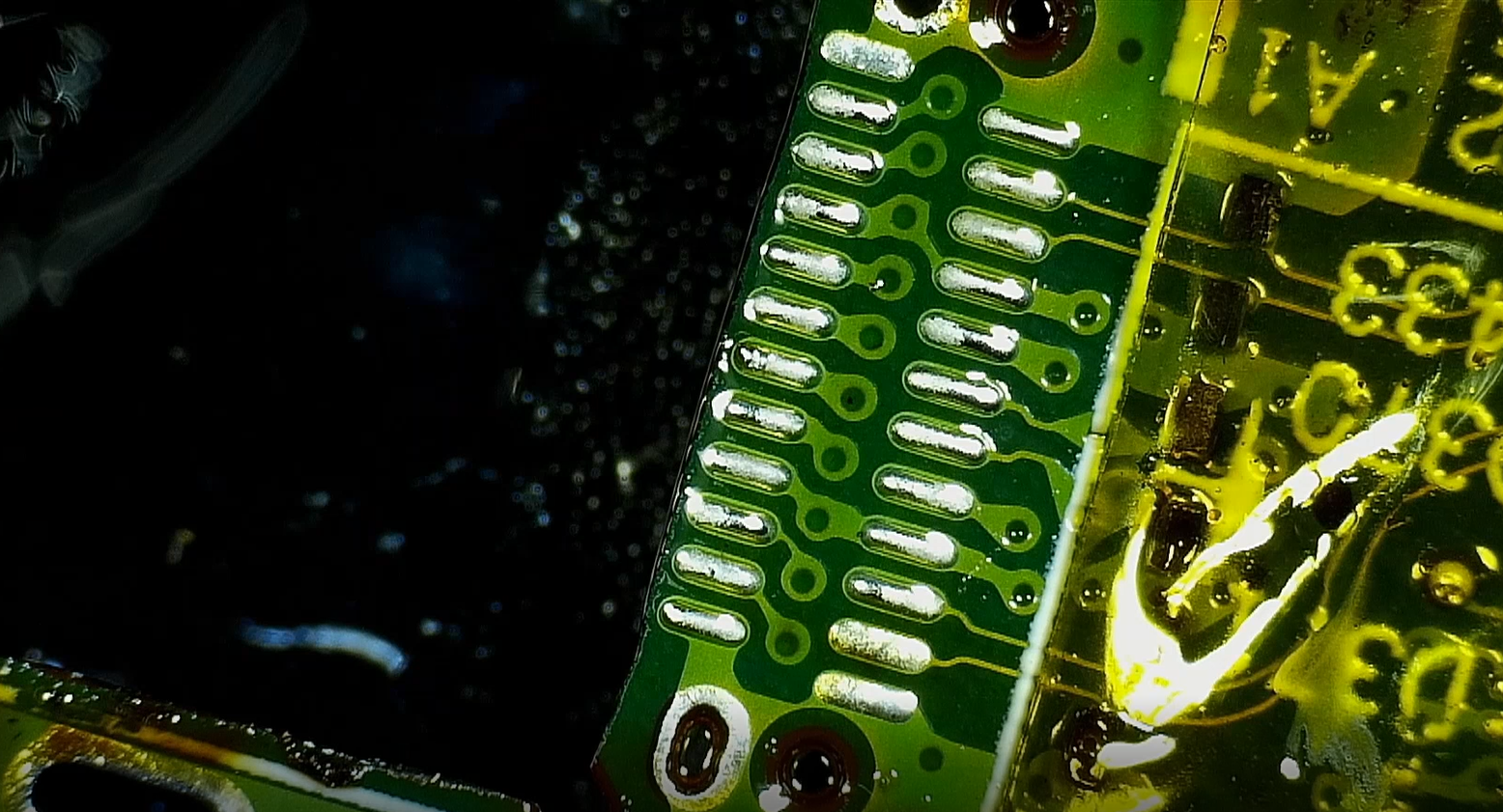
As you can see from the picture above, we were able to remove the USB Type C jack properly and not a single one of the traces got damaged and none of the pads are damaged either. Now that is the reason we don’t want anybody else to try and remove the jack themselves. If we get a board like that with no damaged traces in the back we pretty much guarantee 99% that we can install the new jack and the laptop will work fine.

On a standard DC jack there are just 2 connections that need to be soldered in order for the laptop to power up, a plus and a minus. On a USB type C jacks there are 24 active connections that needs to be soldered to the motherboard. These are 24 tiny hairline connections that take hours to de-solder properly and then solder properly under the microscope. The above laptop is a Lenovo ThinkPad Carbon 6th Gen x1. If you have that model of the laptop send it our way we will fix it no problem.
Case 3: Fully Repairable Trace Damage & Routing
Below is another example of a repairable USB Type-C jack that features a high-density footprint. Even with broken copper tracks, we can route precision jump lines natively to nearby surface components to fully restore factory speed power handshakes.
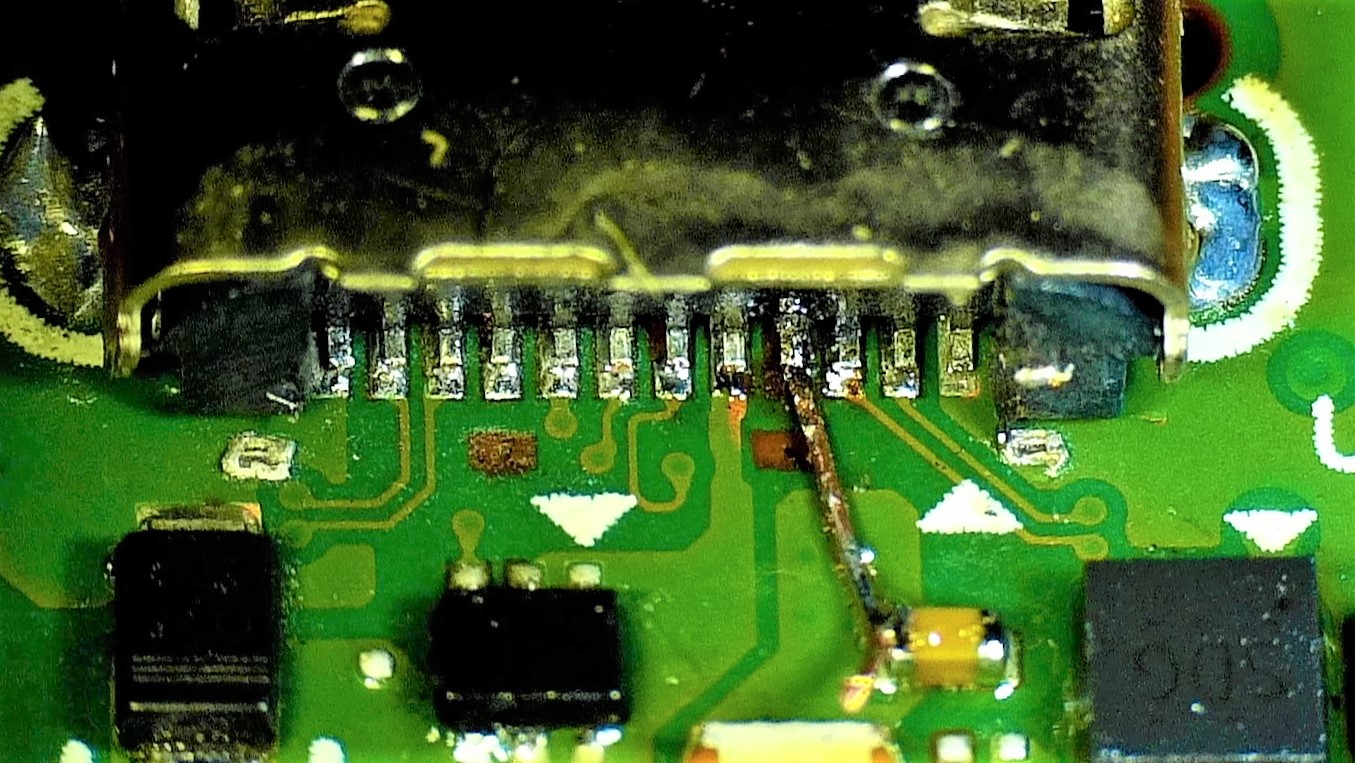
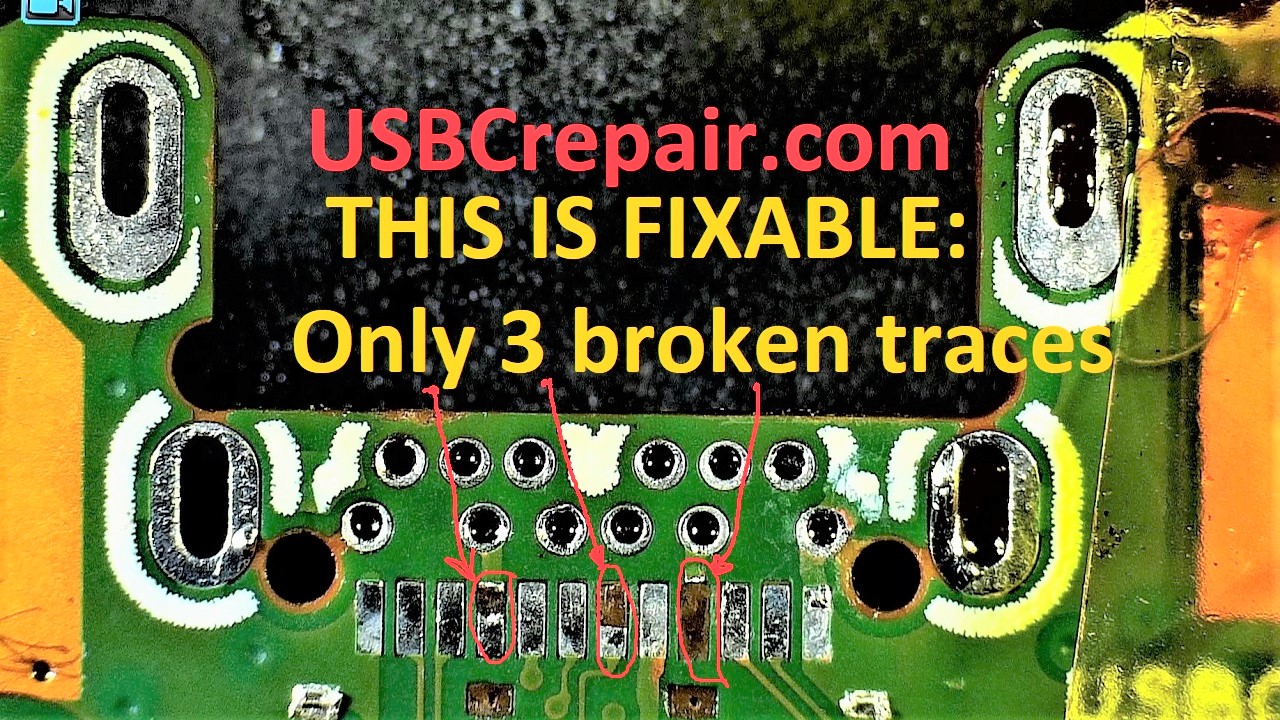
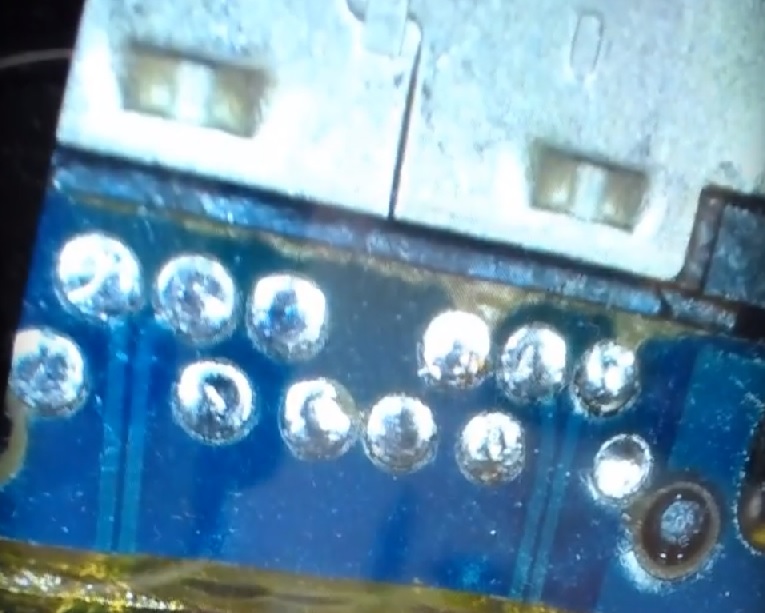
As seen above, the trace was cleanly run directly to the nearest filtering element. The new USB-C jack is perfectly anchored down and every rear terminal leg is loaded with clean solder flow. In environments like this, the device will respond like a brand-new unit with 100% stable charging connectivity.